
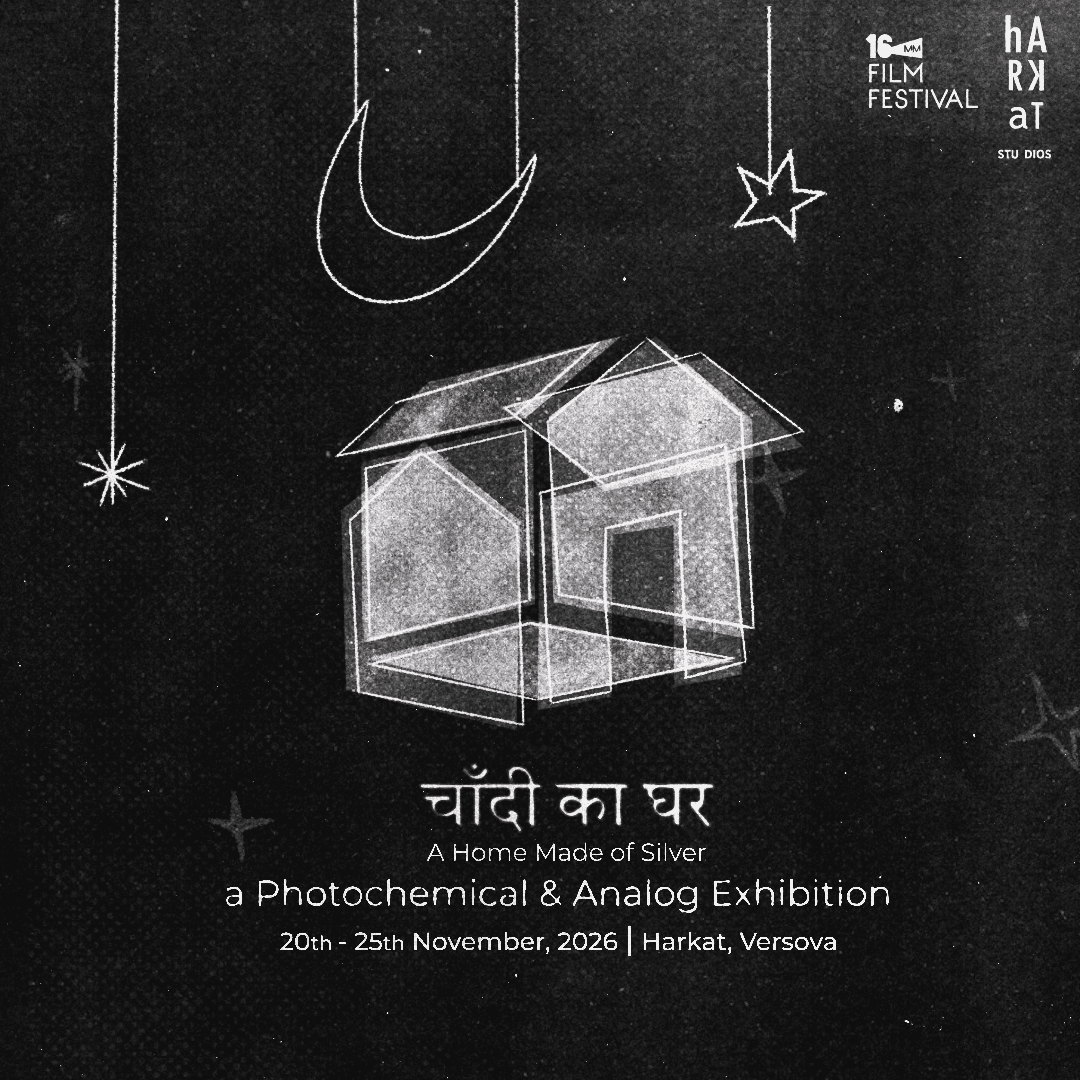
चाँदी का घर
For the past decade, the Harkat Lab has been a home to photochemical and analogue imagemaking processes. Living amongst the young are very old, fragile and sole-surviving machinery and equipment. Prints live on walls, in hidden stacks of paper, under tables. Film, that has long dried, still hangs from the ceiling. A small piece of wall has seen more light than any other. We now want to expand our space and make room for new makers; and this exhibition felt like the best way to fill our home up with more colour and light.
चाँदी का घर (A Home Made of Silver) is a collective showcase of photochemical and analogue image-making from artists and practitioners across India. Our intention with this exhibition is to make the medium more accessible to a larger audience. Housing experimental projects, interactive nooks, and a mini cinema; we hope to see the community carry home with them, a little sprinkle of silver, enough to spark and catalyse their own photochemical practices - or simply find a new medium to appreciate.
Harkat, Versova · Mumbai
20 November: 7 PM onwards · 21–25 November: 4 PM – 9 PM
Featured events
- 20 November · Exhibition Opening + Film Party (guided walk through | terrace party) · 7 PM
- 22 November · Intro to black and white photo prints · 4 PM – 5 PM
- 24 November · Intro to making camera-less films · 4 PM – 5 PM
Featured Works
MOOOOOOOOOOOOOO
OOOOOOOOOOOOOOO
This experiment aimed to examine how the camera captures space and objects, how movement is constructed through a sequence of images, and how spatial relationships are represented within each frame.
A tracking shot of approximately 10 seconds, capturing a moving cow alongside a moving camera, was extracted into 30 individual frames at 3 frames per second. The 30 frames were then composed in two different ways to investigate how the same sequence could be read and
represented through different modes of composition. In the upper half, the images were stitched together by following the trailing figure of the cow, using the moving subject as a point
of reference to construct continuity across the frames. In the second composition, time became the organising parameter. The images were arranged into equal units of stratification,
eliminating the need to follow the cow as a figure and instead allowing the sequence to be organised by the passage of time.Together, the two compositions consider how the organisation
of images influences what becomes visible and what recedes from view. While one maintains the subject as a point of reference, the other shifts attention towards the temporal intervals of its capture, allowing space to be read through the relationship between these successive frames rather than through the subject, the cow, alone.
Medium: Cyanotype on cartridge paper
Memories of a home that doesn’t exist
How does the ocean navigate when the moon disappears forever?
What remains of us when the people and places we are made of disappear? Do we disappear
too? Or do we become the meeting place for this union between worlds?
These photographs are part of an ongoing project exploring the relationship between the living
and the dead, and how we carry death within our bodies as we continue to live. The work
explores the experience of existing as an absence, of being present and absent at once. It
paints images of a memory you’re beginning to forget, a distant memory you’ve never quite
known but have lived with all your life.
The images blur the boundaries between dreams, life and the afterlife. It considers what it might
mean to be the entire universe looking at itself across time, holding memories from decades
apart and experiencing them all at once.
A forgotten memory of meeting someone you will never forget, yet can no longer remember.
A moment that remains with you even as it disappears.
Medium: 35mm film, Mixed media
How little do we need to suggest to translate an emotion or a memory?
There's this tree outside my window. I've known this tree for a few years now, and I've spent a lot of time just looking at it, through sunsets, through rain, through autumn. When you spend so much time looking at a tree and the world around, it invites you into their world that's almost invisible at a quick glance.
You start to notice how the leaves move ever so slightly on a quiet, breezy day. You begin to notice the tiny birds moving around; you can't really see the birds, but you try to spot them by noticing where the leaves are rustling. Sometimes it turns out to be a squirrel, and that's a treat. When it gets dark, you notice fireflies and try to follow their paths every time they glow, slowly beginning to sense a pattern in how they move.
All this makes me think about how much life exists around us that we dismiss because it functions and exists at a pace we are detached from. The world around us demands a certain pace from us, and somewhere along the way, we become blind to all that exists outside that pace. Through this project, I'm trying to recreate moments where I'm experiencing life and movement as still images, to understand what it is that makes an image move.
Cyanotypes offer a visual texture that feels like the act of remembering. Every image comes with a new detail or a slightly different texture, making me relive an already perceived moment through a different lens.
Medium: Cyanotype on archival paper
The dead live inside a lost camera
A week after I lost my mother, I found a kodak KE85 in her drawer that I'd never seen before, a drawer that I had been organising for her all my life.
I found a roll inside it.
I didn't develop that roll for the next 6 months
I thought of it, of her, everyday, I imagined the photos I would find once I develop it, a forgotten life I'll get to relive. Maybe I'll find her inside, maybe she got tired of the city and went back to live inside her father's old film camera. Is she waiting for me? I didn't develop it because it felt nice to look forward to experiencing another first with her, it made her not dead.
The roll was stuck, the camera had melted from within but somehow a few photos survived.
It was from my 8th birthday
Pictures of me,
Pictures of us.
Pictures of laughter.
My baby, I remember everything.
Medium: Prints on archival paper ( Photographs recovered from an expired film roll found inside a damaged Kodak KE85 camera. Only a few images had survived.)
Untitled (Fragmented body)
The work explores the relationship between stillness, the act of posing, and the unpredictability of photographic image-making. Made using a pinhole camera with four apertures positioned on its four sides, the image brings together multiple exposures recorded onto a single surface. Holding a pose for a long exposure requires the body to remain still, without knowing how it will eventually appear in the photograph. The body emerges fragmented, displaced and overlapping with itself, unsettling the expectation of a photograph as a singular, fixed representation. While photography expects stillness and posing as a way of controlling how one is seen, the act of being photographed also involves surrendering some control to the camera and the unpredictability of the image.
360 Pinhole camera
The 360° pinhole camera is constructed with four pin holes positioned on its four sides, each projecting an image onto a single cylindrical photographic surface placed at the centre of the box. The four perspectives are recorded on the same surface, producing a composite image.
Medium: Pinhole negative on silver gelatin paper; digital positive print on Epson Enhanced Matte paper.
Pinhole Camera: Cardboard, Aluminium
From where I belong?
(on going project)
Through this project, I explore questions around gender in relation to both society and nature. The work delves into the internal and external conflicts surrounding identity, and how societal structures often compel individuals to see themselves as ‘different.’ The final outcome is a series of experimental photographs created in the darkroom, where I intentionally disrupted the process to reflect the emotional turbulence of the theme. I worked with both medium format and 35mm cameras, experimenting during the stages of film exposure and development to push the boundaries of the photographic image.
What Remains
This series brings together details of my childhood home and the impressions left by flowers and leaves I collected and pressed over time. I’ve lived with and observed this home since childhood. Its windows, grills and doors are details I’ve returned to through
drawing and painting, and for this series, I wanted to revisit them through a different process. I’m hand-etching these forms into black OHP sheets and using them as negatives to make cyanotypes through sunlight. Alongside these architectural images are the impressions left by dried flowers and leaves on the pages where they were
kept. Some works bring the two together through multiple exposures. The series grew from wanting to work with things that were already familiar to me, but to see what happens when I translate them into another medium.
Medium: Cyanotype prints on paper, using hand-etched negatives and botanical impressions.
ਚਾਹ (translates to: desire/ longing)
Through this work, I look at understanding the entanglements of a nostalgia for a
homeland and childhood. Our childhoods are our lived experiences whereas our ideas of watan might not be. This entanglement exists within a liminal space that we struggle to reach or go back to but can never do so. Why do we associate ourselves with a homeland that does not exist? How does this association to something essentially non-existent connect to our very real experiences that we simply cannot go back to?
Medium: Cyanotype on cloth
Timepieces
Slow Down. What you see here is an image made of metallic silver, affixed on a blackened aluminum plate - rendered entirely by a hand-made and an in-camera process dating back to 1851. Call it a polaroid picture, made almost as instantly as it was shot. Chemicals react to the invisible UV light alone, and a “perfect collodion image” is a tight rope walk with a blindfold on. But no. One learns to see in the dark and the art is not very different from a science. We pour the collodion, the developer and the varnish, and if the plate survives all of this, it will outlive the photographer for more than 200 years – a timepiece enshrined in silver.
Medium: Wet-Plate-Collodion Tintypes
Remembrance
Remembrance is a photographic series that documents the collective anger, grief, and resistance of India's younger generation as they take to the streets demanding justice and accountability from a state that has repeatedly failed to safeguard their futures. Emerging from the protests against examination paper leaks, the demand for re-examinations, and the lack of accountability among those in power, this series captures a generation pushed to the limits of its patience. It is a visual testimony to the frustration of students whose dreams, years of preparation, and aspirations have been compromised by systemic failures within India's education system.
Photographed on a Minolta SRT 101 using black-and-white film, Remembrance approaches this political moment through the materiality of analog photography. The grain, contrast, and imperfections of film reflect the rawness of the emotions unfolding in the streets. The absence of colour strips the images of distraction, drawing attention towards the faces, gestures, bodies, and expressions of those gathered in protest. Each photograph becomes more than a record of an event; it becomes a fragment of a shared experience, preserving moments that might otherwise disappear within the constant circulation of news and digital images.
At its heart, Remembrance is concerned with the relationship between memory and resistance. The title reflects the artist's desire to ensure that this particular day is never forgotten. It remembers the people who assembled, the voices that demanded justice. It is both an archive and an invitation. It asks the people of India to remember what brought them together, what they stood against, and what remains unresolved. By preserving this moment on film, the artist hopes to create a memory that can be returned to whenever silence is imposed or accountability is denied. It is a reminder that if the need arises again, we must remember how we once stood together, and find the courage to assemble once more.
Saree Shop
Taken on 4x5 Ilford HP5 this 16x20 silver gelatin print shows a saree shop with its owner in
Malad. The wide angle combined with flash draws the viewer into the small shop and to the
sweet man. His welcoming smile draws your eyes in and invites you to explore the whole busy
Image.
Truck Cab
Taken on 4x5 Ilford HP5 this 16x20 silver gelatin print shows Rohit in his truck while he stopped
for breakfast near Mazgaon Docks. He was kind and welcoming, and invited me into his truck
after I photographed him outside. This photo with its wide angle lens makes the view feel like
they have been invited inside as well to see how fantastic his cab truly is.
Medium: Silver gelation print
Far and Within
My work explores the multiplicity of time and memory, and my experience of moving through spaces that shape my sense of belonging. I see myself afloat between places I continue to inhabit and those I have left behind. By isolating forms and constructing narratives around them, my images evoke a sense of placeless-ness, where familiar surroundings become detached from their original contexts.
This series reinterprets my photographs through cyanotype prints, merging images of places I still visit with those I have left. The window becomes a motif, acting as a passage to the outside world and a surface through which we interpret our surroundings. It embodies the duality of looking outwards while turning inwards, of being connected to the world while remaining separate from it. While elements such as fabric lend the images a sense of lightness and fluidity, the window also takes on the quality of a wall, distant, closed off, and inaccessible. Through layered and distorted compositions, I explore emptiness, seeking, return, and longing. The window becomes a canvas for these emotions, reflecting how memories of places are continually reconstructed through personal experience. Drawn to the spaces in between, I explore how places remain with us long after we have left them.
Medium: Silver gelatin prints, Cyanotype on paper, Cyanotype on cloth
Longing
Self-portrait created as cyanotype prints on watercolour paper, hand-embroidered and coffee-toned.
Medium: Cyanotype on watercolor paper, toned with coffee and green tea
Brain Damage
Brain Damage explores the relationship between the self and the mind as two seemingly separate entities. It begins with the idea of confronting your own brain, almost as if it were a different identity—something you have to sit across from, question, and negotiate with. The mind becomes both the one speaking and the one being spoken to. The series moves from conflict to collapse to transformation, exploring the possibility that confronting what exists within us can make room for something beautiful to emerge.
Medium: Cyanotype on watercolor paper, toned with coffee, hand-embroidered
Tat Tvam Asi
Medium: Cyanotype on paper, woven and tea-toned
Additional works made by artists from the Harkat Collective
Mini Cinema
Magic Tricks
A magician gives a stuffed rabbit the chance to experience all of the beauty and sorrow the world has to offer. This magical spectacle was shot on 16mm film and hand processed in eco developer.
Levures sauvages
In a distant future, Brussels is the last livable place on earth, thanks to its regular rain. The flooded city is overrun by wild brewer’s yeasts that are starting to ferment. Facing this new threat, a commission of randomly selected residents was asked to define a strategy.
Clairière
Revisiting once familiar spaces, a dialogue of respite in temporary sanctuaries.
The Onus is On Me
“The Onus Is On Me” is a three-channel 16mm projection installation that re-imagines the title as a tactile, embodied experience. The piece abstracts language through in-camera title design on 16mm, employing a monologue that explores perception and escapism. Traditional elements of title design—language, typography, and motion—are used within the frame to emphasize the directionality and physicality of speech. The construction and motion of the type are personified: a custom variable typeface swings from left to right while a marquee animation replicates the rhythm in which words are read and absorbed. The dramatic reading adopts a monologue, a literary device grounded in the body. The protagonist, who dreams of acting, is dissatisfied with how they are perceived. They believe favorable impressions derive from the onlooker’s psychological bias, as if no one projects onto them. Escapism becomes the coping mechanism, symbolized by abstract silk-screened frames in the middle channel, contrasting with the side channels (traveling mattes) that represent reality through horizontal, pulsating typographic movements.
(Only a recorded digital copy of the installation will be screened at the exhibition)
What You Don’t See
This film is about what the audience doesn't see when we watch a film – the sprockets, the optical soundtrack, the splicing tape, the celluloid itself, the frame lines, etc.
This is a very short Direct Animation film I made at MONO NO AWARE in Brooklyn. It's totally Analog and was made using only 16 mm and Super 8 found footage films strips.
The Canopy Within
Within a city full of brick, concrete, metal, people, and noise, my houseplants offer a serene respite. Captured on 16mm color reversal film with the use of macro lens adaptors, the plants’ textures and colors are amplified, exposing my awe and wonder for their individual characteristics.
A Brilliant Sky
“A Brilliant Sky” is a 16mm piece that attempts to condense, in a single roll of film, the full range of colors and nuances of a changing sky. Shot frame by frame in chronological order over two weeks, the film accompanies the gradual succession of days and nights, keeping the sky as its sole motif.
The Llama That Kindles The Wetland
Set in the misty highlands of central-eastern Ecuador, the film follows Gael, Dylan, Cristopher, and Jasmín in the days leading up to La Llamingada, a race rooted in a local syncretic tradition. Amid the steady rhythm of everyday rituals, gestures of care, companionship, and domestication unfold beneath the breath of the mountains. A whistle echoes across the valleys; a shearing comb and a leather whip become instruments that mediate the relationship between human and non-human worlds, revealing bonds shaped by tenderness and labor.
Guided by Andean cosmologies, the film moves through pacha—space and time understood as a single living fabric—where the spiritual and the material intertwine like threads within the same weave. Within this landscape, the tensions between domestication and syncretism converge through a communal ritual, revealing the intricate entanglements of power, intimacy, and spirit that continue to shape the contemporary Andean world.
The film’s soundscape draws inspiration from the work of Mesías Maiguashca, a prominent figure in Ecuadorian sound art, particularly his sensitivity to acoustic space and his ability to weave natural and synthetic sounds into layered sonic environments. Following this approach, the film listens to the páramo as an active presence: one that carries memory, spirituality, and affect across bodies and territories.